
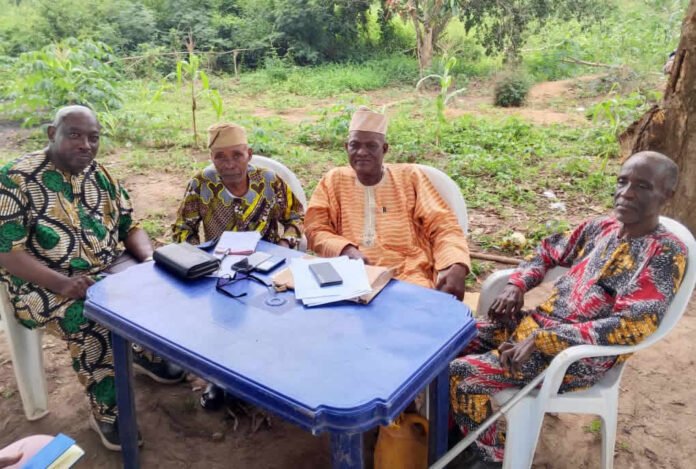
Established decades ago under Chief Obafemi Awolowo’s vision, Ilewo Orile Farm Settlement remains alive today. With 385 hectares under cultivation, the community, led by Engr. Jagun Abiodun is working to balance tradition with modern farming practices while pressing for better mechanization and fairer access to loans.
What type of crops or livestock do you primarily cultivate or raise?
We primarily raise poultry and pigs, but farmers here are free to also keep sheep, goats, or even cattle. For crops, we mostly plant cassava, maize, and vegetables. We now plan to go into large-scale production of soybeans because we have been having problems with herders and their cattle. We believe cattle will not disturb soybean fields, so we are moving into soybeans. Likewise, we also cultivate vegetables such as pepper, okra, tomatoes, and
others. We even have a dam here, so anyone interested in fishing can also do that. We plan to use the dam for dry-season cropping through irrigation farming.
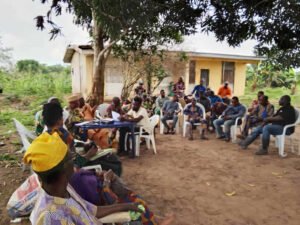 What is the name of this community?
This community is called Ilewo Orile Farm Settlement. It is one of the eight farm settlements established in Ogun State. In fact, about thirty farm settlements were created by Awolowo in those days across the entire Western Region. Twenty-eight are spread across Lagos, Ogun, Oyo, Ondo, and Osun States. Out of these, eight are located in Ogun State, and Ilewo Orile is one of them.
How many hectares or acres do you currently farm on?
Altogether, we farm on about 385 hectares. One hectare is about 2.5 acres, or 100 by 100 meters in size.
Do you use improved or hybrid seeds, including genetically modified (GMO) seeds?
Yes, we have been hearing about GMO, but we have not cultivated GMO here. We normally buy our seeds from agricultural services in town. If we want to plant maize or cassava, we need to go and sort for it if we don’t have enough seeds. We have not been cultivating GMO seeds at all, in fact, we advise against it.
Why do you not use GMO seeds?
It is because they cannot be reproduced. If you plant GMO seeds now, you cannot reproduce them; you will have to go and buy them again next season. With our own seeds, we can plant and keep some for future years. GMO seeds are a way to tie farmers down, so if they are not supplied, it means there will be no planting that year.
What are your main sources of agricultural input (seeds, fertilizer, tools)?
We normally source our fertilizer from the government. In fact, at some point, they gave us fertilizer last year free of charge. They gave us so many bags, and we buy agrochemicals from town, sometimes from the government. It is usually cheaper to get it from the government.
 You mentioned irrigation; as an irrigation engineer, do you have access to any irrigation system on the land, or is it mainly rain-fed agriculture?
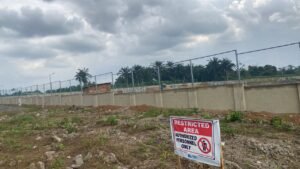
It is majorly rain-fed agriculture, and we have a dam somewhere on the farm that we hope to use for dry-season irrigation farming. Hopefully, very soon, that will be in place.
What about boreholes?
We don’t have boreholes yet, but the local government chairman has promised to provide them, along with solar lights. During a meeting we had with him on March 28, he also promised to grade the road from Ilewo town to the farm settlement.
Have you received any formal agricultural training in the past few years?
Yes, we normally receive training from the agricultural institute. We have training from several sources, and these trainings last for one week at times. The International Institute of Tropical Agriculture (IITA) has come to train our people on maize production and how to prevent diseases on plants. It has been very helpful.
What are the biggest challenges you have faced as a farmer in Ogun State?
The biggest challenge is mechanization, that is, tractors and equipment. As a matter of fact, most of the land here is not tractorable because of thick bushes. However, the World Bank has stepped in to support Ogun State by providing tractors and equipment through the government. We are still waiting for the distribution of these machines. They have already supplied many tractors, planters, and combine harvesters under the OPSD program. The World Bank is also building a solar dryer, a produce warehouse, and a shed for us here at Ilewo Orile Settlement.
How do you sell this product?
We take it to the market.
 Do you have a local market or cooperative that helps you, or do you sell individually?
We have a cooperative, but we have not been using it for sales. Farmers here sell individually. For example, when I have maize, I take it to the feed miller and sell it at the current market price.
You said you want this place to be known for a particular product?
Yes, we want to make this settlement a soybean hub, with more soybean plots, though we will continue planting cassava and maize as well.
Do you belong to any cooperative?
Yes, we do. It has been helpful because, as a cooperative society, we can come together and borrow money from ourselves.
What is the name of the cooperative?
It is called Ayomide Ilewo Orile Multipurpose Society.
Do you currently have access to government or NGO support?
Yes, we have benefited from programs such as STEP under Augustep Farmers through the Ilewo Orile Farm Settlement Cooperative Farming Society. We once received a 50% grant, and currently, a group of twelve of us has a 12-hectare maize program. We also work with IFAD (International Fund for Agricultural Development), which has promised us a cassava processing machine. We have been waiting for about five years, and they assured us we will get it this year.
Are you open to adopting new farm technologies?
Yes, of course. Machines and digital tools can greatly improve our farming activities.
How have climate and weather changes affected farming?
It has affected us greatly. I am a victim myself. Last year, I cultivated three hectares of cassava and maize. I planted in June, but there was no rain at all throughout July. That is why we are working on the dam for irrigation.
Do you have access to agricultural loans?
Yes, but they are hardly available in reality. Two to three years ago, under the Anchor Borrowers Program, about 40 of us formed a group and met all the requirements for a loan. At the final stage, we were told we would not get it. We later learned that in some northern states, farmers were being paid in cash, but here, despite completing all the formalities, we were denied. It was very discouraging.
From the Agricultural Bank, I was once asked to open an account, which I did.
But when it was time to access a loan of ₦350,000, they asked me to bring a
guarantor from the ministry, a civil servant above level seven in Ogun State. That
has made it very difficult for farmers like us to benefit.