
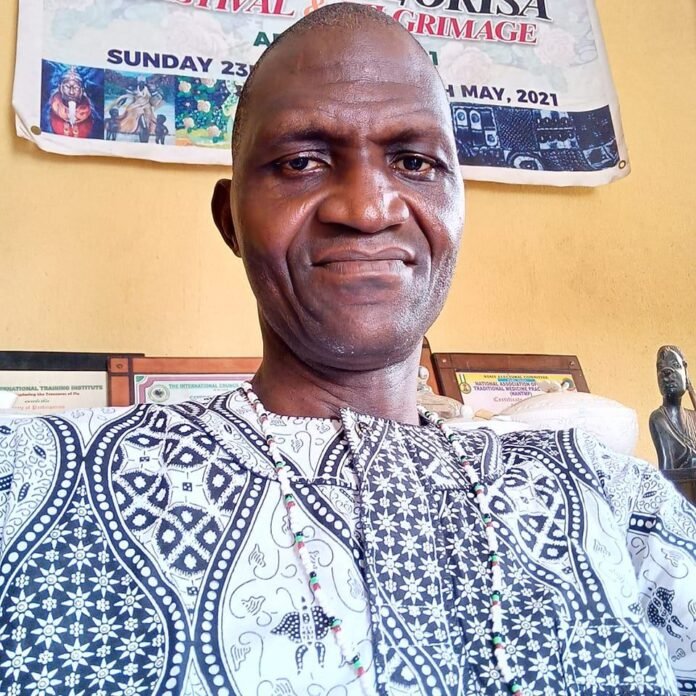
Mr. Akometafe Wande Olomitutu former secretary general of the International Council of Ifa and Orisa Spirituality and the Oluwo of Ona Owuro School of Ifa Study. In this Interview with Femi Ajape, he speaks on how he attended church from a young age until when he graduated from the university, and how he embraced the Ifa tradition. Excerpts:
How did you find yourself in the Ifa traditional worship?
I was born into a family that practices the Yoruba traditional worship. My father was a revered spiritual leader, and I am continuing that legacy. While we were young, we had the liberty to choose our own paths, so my father did not force any of us to follow in his footsteps. As a child, I attended church, and I continued to do so throughout my university days, However, after graduation, I found life to be quite challenging. I graduated but struggled to find meaningful work. Upon returning home, I began to question why things were this way and sought answers. I was informed that I needed to follow the path ordained for me. Initially, I was hesitant about being initiated into Ifa, especially as someone who identified as a born-again Christian. It was a difficult decision for me. I eventually got a job with an oil company in Apapa, Lagos, but I felt unfulfilled. Despite having a good job as a professional accountant, I lacked joy and purpose. This led me to ask more questions, ultimately guiding me to my current path.
What inspired your devotion to this path?
I would say it’s a matter of truthfulness and the natural order. There are over a thousand religions in the world, and I believe all religions are man-made What the Creator has given us are laws, while everything else is constructed by humans. What makes me happy in this path is the emphasis on truthfulness. There’s no compulsion in traditional worship, unlike some religions that spend vast amounts to convert others, we do not force anyone to join us. I’ve learned that the essential things in life, like water and food, don’t need advertising. Witnessing the positive impact of traditional worship on community well-being, cultural preservation, and family unity has inspired my devotion. The respect for our ancestors, nature, and the divine has strengthened my commitment, a has the rich cultural heritage and spiritual depth of our traditions. I believe there is no single path to the divine; Olodumare has guided some to follow Jesus, others to follow Mohammed, and some to follow traditional paths.
What challenges do you face as a traditional worshipper in modern society?
One major challenge is societal perception. Many view traditionalists as bad people, labelling us negatively. Other challenges are balancing traditional practices with modern societal expectations, addressing misconceptions and stigma associated with traditional worship, preserving cultural heritage amidst urbanization and globalization, adapting to changing societal norms and values, limited government support for traditional worship. There’s also a kind of discrimination, people often judge based on appearances rather than character. Nigeria, on paper, may seem to embrace various religions, but we see a lack of support for traditional practices. For instance, we hear about government subsidies for religious trips to Mecca or Jerusalem while neglecting our spiritual sites, which are equally significant. As one verse in Ifa says, we often do not value what we have at home. Despite these challenges, we continue to move forward and strive for understanding.
How do you pass down traditional knowledge to the younger generation?
We have various methods of passing down knowledge, these include through oral teachings and storytelling, apprenticeships and mentorship, cultural events, workshops, and festivals, community engagement and participation, integrating traditional values into modern education. Currently, we have about 18 students studying here, most of whom are secondary school graduates. They stay for a period, usually until they gain university admission. It’s crucial to impart this knowledge to prevent it from being lost. Many of our elders did not keep records of traditional practices, which posed a challenge. However, we are seeing more interest from people, including lawyers and professionals, who wish to learn Ifa. We also teach online, reaching a broader audience.
How do you view your interaction with others of different faiths?
The first step is recognizing our shared humanity. We should focus on mutual understanding and respect, cultural exchange and learning, collaboration on shared human values, building bridges between communities, fostering peace and cooperation. Interfaith dialogue is essential for breaking down stereotypes and promoting tolerance. Through open communication, empathy, and a willingness to learn, we can discover commonalities, appreciate differences, and work together for the greater good. Ultimately, these interactions remind us that despite our differences, we share a common humanity.
Have you encountered any misconceptions about traditional worship?
Definitely, common misconceptions include people seeing the traditional faith as primitive or backward. It is also associated with idolatry, among others
How do you foster understanding and respect between different faith communities?
As I mentioned earlier, we do not force people to join us. Unlike some religions that threaten hellfire for non-believers, we believe that one’s character speaks volumes. We encourage peaceful coexistence and mutual respect through
Can you share your experiences of interfaith collaboration or dialogue?
Recently, I participated in a roundtable dialogue at the Institute of Church and Society in Ibadan, where we engaged with both Muslim and Christian leaders. It was a positive experience. In my travels to developed countries, I noticed that many people are less religious and are more focused on discussing the issues that cause religious conflicts. I believe the government should play a role in regulating religious practices to prevent misunderstandings and tensions.
What are the most significant challenges facing traditional worshippers today?
One significant challenge is government recognition. If we received even a fraction of the support given to Christian and Muslim communities, it would greatly benefit our tradition. History has been removed from our curriculum, leaving many unaware of their heritage while learning about foreign histories. The government often supports specific religious celebrations while neglecting us.
What is your advice to members of the society?
My advice is simple, embrace your own traditions. Your heritage is your identity. As Yoruba people, we should uphold our traditions and not forget our roots. Recently, I heard a pastor claim that his prayers for couples are more important than those of their parents. This is concerning. When a child is born, traditional practices should guide their upbringing. For example, when Jesus was born, his parents consulted wise men who were traditionalists. We have strayed from those practices, and it has led us to our current challenges. I urge people to return to their roots and honour their traditions
I see many plaques and awards here. What are they for?
1 am a professional accountant and Babalawo. Most of these awards were given to me for my engagement and contributions to society, particularly in advancing the growth of Isese (traditional religion). Many awards were collected on my behalf due to my busy schedule, and I am grateful to Olodumare for the recognitions.