
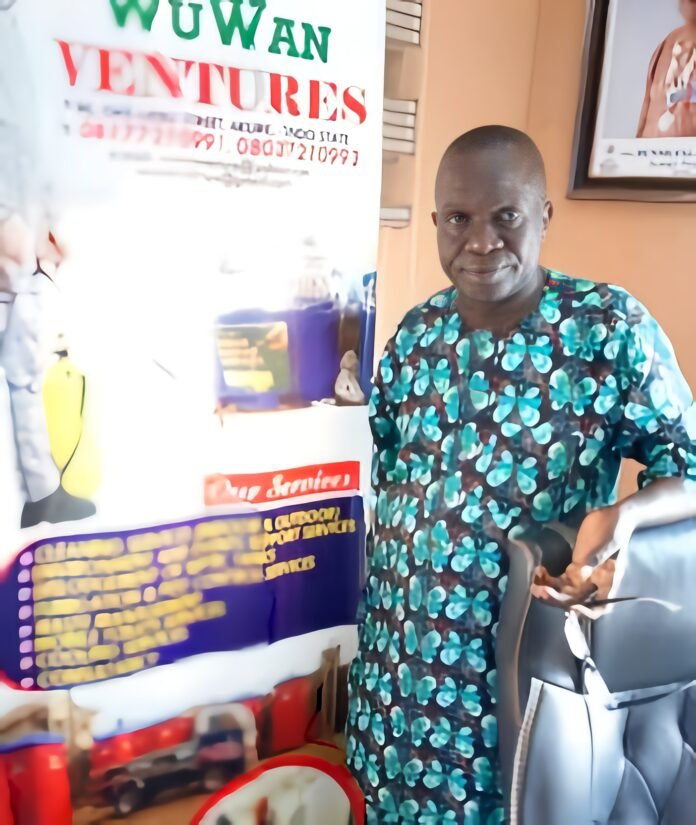
Bunmi Falodun is the Chief Executive Officer (CEO) of WuWan Ventures, an environment and cleaning services company. In this interview with Femi Ajape, he speaks on how government can help small businesses thrive in the country. Excerpts:
Can we get to know you, sir?
My name is Bunmi Falodun, the CEO of WuWan Venture, we are into environment and cleaning services, I’m a trained environmentalist, I have a Higher National Diploma (HND) in environmental management; a BSc in Health Education and Masters in Environmental Management. I had worked in different management and retired as a director in Ondo State Civil Service.
You have told us you are an environmentalist, but what do you do exactly?
From my background, as an environmentalist, I discovered that prevention is cheaper than cure. The amount of money we spend on treatment higher than the money spend on prevention. It’s cheaper because the moment you’re sick, it consumes your time, energy and money. This prompted me to establish the business. We do indoor and outdoor services, fumigation services, event support services, dislodgement of waste, fumigation and pest control, we also provide mobile toilet at events, and we are into cooling services.
We are consultant to some agents like World Bank, UNICEF, including the state government and other organizations that need our wealth of experience. It’s a registered company.
What are the challenges you encounter in your line of your business, both personal and those to be considered as social problems?
The capital investment required for this waste management service is substantial. In recent years, costs have skyrocketed. For instance, a mobile toilet that sold for N500,000 some years ago now costs 2.5 million. The chemicals used for fumigation and pest control are unaffordable. Unlike in Lagos, where waste managers receive government support, we face numerous challenges here. The government’s recent efforts to provide subsidies for equipment and services are minimal compared to our total operational costs. Spare parts are particularly expensive, with a single floor shark for a mobile toilet costing around N250,000. So the inflation in the country is really affecting small businesses. Additional challenges we face include poor road networks, hindering waste collection from households, inadequate house designs, obstructing easy waste removal, among others. However, despite these challenges, this business remains viable as it provides essential promotive health services.
The Nigerian economy is said to be experiencing some tough times, in what ways is this affecting your business?
I mentioned part of this when I was answering your question about challenges. This issue is national, even global, as everyone knows Nigeria’s economy is struggling. It affects every aspect of life, no matter how small. Take, for instance, the cost of goods; what we used to buy for around N150 now costs over N1,000. Similarly, the chemicals we use, which previously cost around N1,000 per litre, now cost N16,000 to N18,000.
As a result, many people are abandoning this business, especially public service participants who can’t sustain themselves. They’re forced to leave the system. It’s impacting us severely, but all we can do is persevere and hope for better days ahead
Fumigation and general fumigation both for domestic and industrial purposes seem to be in high demand because of prevalence of mosquitoes, rodents, and other pollutants, what do you have to say about this assertion?
Let me dispel the notion that fumigation services are in high demand. In reality, people often undervalue them. Instead, they opt for makeshift solutions, which I refer to as blanket spraying. This involves buying chemicals, mixing them with kerosene, and spraying them without proper expertise.
Ideally, fumigation should encompass integrated pest management (IPM), a comprehensive approach that considers the ecosystem, pest life cycles, and targeted treatments. However, this nuanced understanding is often overlooked.
We have various sectors, including agricultural, domestic/home-based, and industrial, totalling around six or seven. However, each sector requires specific chemicals. For instance, agricultural chemicals differ from those used domestically.
Unfortunately, in our context, anyone can handle chemicals without proper knowledge of the pest type or relevant chemical. We don’t practice Integrated Pest Management (IPM) here; instead, we focus on pest control or blanket spraying’ without consideration for the specific pest species.
This approach is concerning, as people buy harmful chemicals like Sniper, which can contaminate food. A systematic approach is essential, but many individuals simply carry pumps and spray without proper protection. Handlers should wear protective gear, including masks, gloves, and suits. I have my kit here, and there’s a specified way to wear it. Eateries, in particular, require regular fumigation, at least twice a year, and must obtain certificates to confirm their premises are pest-free.
How do you source your clients, do they come to you, or you reach out to them directly through advertisements?
Our marketing strategy is two-fold: we search for clients, and they also find us. We utilize various channels, including: advertisements, referral systems, social media promotion by satisfied clients, vendor networking through associations, radio sponsorships (eg., every Wednesday, 10-11 am). Our office is located at Number 80, Oke ijebu road, Akure. We also partner with event planners and vendors to offer our services.
In this region, open defecation is prohibited, making mobile toilets essential for events. Unfortunately, some organizers neglect this, leading to unsanitary conditions. Our mobile toilet services aim to address this issue.
What is the range of cost of a domestic fumigation and general cleaning, can an average Nigerian afford it at this time?
The question is highly relevant. Currently, the average Nigerian struggles to afford three square meals due to the high cost of living.
I recently did fumigation for someone, charging N65,000 for a three-bedroom flat, considering our relationship. Interestingly, the neighbouring buildings benefited from the fumigation as well. For instance, a dog in an adjacent compound had ticks that dropped off their premises.
The owners acknowledged the effectiveness of my service and appreciated it. However, affordability is an issue. Even basic blanket spraying costs around N20,000 to N25,000. A single litre of chemical costs approximately N10,000, and multiple litres are needed to address various pests.
Different pests require specific treatments; what works for snakes, may not work for rats. Those who prioritize their health and clean environment invest in proper fumigation. While it may not be affordable for everyone, people adjust their budgets to make ends meet, just as they do with food.
Does the government support you in any way, and do the government or her departments and parastatals engage your services both at local government and state levels?
Thank you. We consider that support. The government patronizes us because they’ve realized they can’t do it alone. Managing environmental waste is a massive task that requires collaboration. That’s why they allow private individuals to handle certain aspects of waste management.
The government’s role is to supervise, moderate, monitor, and regulate. Some individuals have even purchased their equipment and been assigned zones to operate in. We pay taxes to the government, but unfortunately, we haven’t received the same level of support as states like Lagos or Abuja.
How lucrative is this form of business, and what advice can you extend to anyone interested in going into such a business?
Importing sludge and mobile toilets into Nigeria offers a two-pronged income stream. When evacuating sludge from septic tanks, you can sell it manually to farmers as fertilizer, generating dual revenue.
Firstly, the premises from which you evacuate the sludge pay for the service. Secondly, farmers pay for the fertilizer. This business is lucrative but highly capital-intensive.
Initially, demand was low, and costs were manageable. However, prices have skyrocketed A lorry tire that once cost between N35,000 and N60,000 now exceeds N300,000. My truck requires 10 tires, and I recently purchased two, only to have them burst at the landfill. I had to buy another set, totalling N3 million.
Challenges abound, including road problems and high operational costs. However, if other factors are favourable, this business can be very profitable. In fact, abroad, entrepreneurs thrive in this sector due to efficient road networks. During my visit to Paris, I saw single operators managing computerized trucks. Here, it’s manual labor, requiring 5-6 workers per truck, incurring additional payroll expenses.
What policy or policies can you advise the government to enact that will persuade, force or encourage general cleanness of our country?
Thank you. We have policies addressing health and environmental issues at various levels: local, state, federal, and even World Health Organization guidelines. These policies outline rules for individuals and governments to mitigate health problems and environmental concerns.
However, the major challenge lies in changing people’s attitudes. Nigerians often resist adopting proper waste disposal practices, leading to issues like flooding in some states. Waste generation is a daily concern; every household produces waste and requires safe water.
Unlike developed countries, where waste is sorted and managed efficiently, we combine different types of waste plastic, bottles, and degenerated waste and dispose of them improperly, often dumping them into waterways. In a very clean and decent environment, I believe we will be healthier than we are currently experiencing. We have laws in place, in addition to policies and health education aimed at informing and persuading people. However, we also have litigation for those who refuse to obey these established laws, and they can be taken to court for necessary punishment. Every last Saturday of the month is dedicated to environmental sanitation, during which household movement is restricted. This restriction may be lifted only in the case of a national assignment that takes precedence. Therefore, there is enforcement of both these policies and the law.
Lassa fever, malaria, typhoid fever, cholera, and other such infectious diseases are attributed to poor general hygiene, your line of business tends to seek a cleaner environment to prevent those diseases, what advice can you give to the public to protect the environment from these diseases?
We have two main categories of diseases: communicable and non-communicable. However, diseases like cholera, typhoid, malaria, and other infectious diseases are
preventable. A clean environment is key to preventing these diseases, which primarily originate from contaminated water, land, or food.
The food supply chain, from farm to vendor to consumer, plays a significant role in disease transmission. Poor environmental practices, such as dumping refuse, create habitats for disease-carrying rodents and pests. These pests can contaminate food, leading to the spread of diseases.
To prevent these diseases, personal hygiene and environmental cleanliness are crucial. Regular fumigation, proper food handling. and cooking are essential. Governments and organizations like UNICEF and the Federal Ministry are working to address these issues.
By changing our attitudes toward personal hygiene, environmental cleanliness, and sanitation, we can significantly reduce the incidence of preventable diseases. Living in a decent environment with good habits can make a significant difference in our overall health and well-being.
We have two main categories of diseases: communicable and non-communicable. However, diseases like cholera, typhoid, malaria, and other infectious diseases are preventable. A clean environment is key to preventing these diseases, which primarily originate from contaminated water, land, or food.
The Federal, state, and local governments are taking measures to address health concerns, especially with the current Lassa fever outbreak. They are taking swift action, and it’s heartening to see them proactive. If our people intensify efforts to keep the environment clean, healthy, and sustainable, we can live a healthy and purposeful life.
An unhealthy person cannot live a fulfilling life. When sick, you waste time, money, and endure pain. Therefore, we will continue to advise our people, promote awareness, educate them, and partner with media outlets to spread the message.