
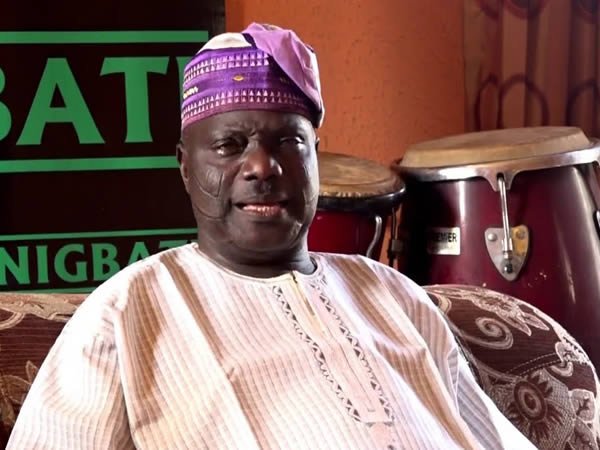
From the streets of Iseyin to the bustling stages of Lagos, Prof. Y.K. Ajao has lived a life deeply woven into music. Trained under the legendary Sola West in Ibadan and later mentored by King Sunny Ade, Ajao carved a path for himself by daring to be different. His bold decision to infuse Cameroonian Makossa with Nigerian Juju gave birth to a new sound that many resisted at first, but later embraced. Today, he is celebrated not just as a musician, but as an innovator who stood firm against the odds to create something truly
original.
Can we meet you, sir?
I am Yekini Kolawole Ajao, popularly known as Prof. Y.K. Ajao. Some people also call me the “Makossa Superstar.”
 Can you tell us about your early beginnings in music and how growing up in Iseyin influenced your career?
My journey into music started in 1961. I grew up in Iseyin, a town with a very rich cultural background where music and tradition are part of daily life. As a young boy, I was fascinated by all the music around me.
By 1971, I moved to Lagos to pursue my music career more seriously. But before that, I played locally in my town, learning the basics and performing at small gatherings. Those early days in Iseyin grounded me. They gave me discipline, resilience, and the passion that later helped me when I faced challenges in Lagos and beyond.
What was your experience like playing with a band in Ibadan before forming your own group, the Professional Brothers Band?
Before coming fully into Lagos, I spent time in Ibadan where I was trained by my master, Sola West. I learned not just how to play instruments, but how to lead a band, how to arrange music, and how to connect with an audience.
At some point, my father insisted I return to Iseyin to complete my Secondary School education, and I obeyed. But music never left me. Once I finished my education, I returned to Ibadan and later to Lagos with more focus. Eventually, I formed my own band, which became known as the Professional Brothers Band. That was the beginning of my real identity in the Nigerian music scene.
What inspired you to create your unique style, Makossa Superstar, and how did it differ from your earlier works?
In the beginning, I loved to play in the style of Chief Commander Ebenezer Obey. Everybody loved his sound at that time. But as an artist, you always feel the urge to create something that people will remember you for.
My turning point came during a trip to Cameroon. While passing through Yaoundé, I heard a sound that I enjoyed deeply. It was different, it was rhythmic, it was vibrant. They called it Makossa. I bought a record, and when I returned to Lagos, I began to study it closely.
 So, I created a fusion of Makossa and Juju, which became my unique style later branded as “Makossa Superstar.” At first, many Nigerian fans did not accept it. They were so used to the traditional juju sounds played at ceremonies that they found my style too unusual. But with persistence, I pushed it. And over time, people began to embrace it. That experience taught me that Nigerians sometimes resist new things until they see the value.
How did Shina Peters’ introduction of ACE music shape your decision to adapt and redefine your sound?
Every musician has his calling. God gave me my own style, just as He gave Shina Peters his Afro-Juju (ACE) sound. For me, Shina’s emergence was not competition, it was inspiration. It showed that there is space for everyone to innovate. Seeing how Nigerians embraced his new rhythm encouraged me to stand firm with mine. It reminded me that if you stay true to your unique sound, your time will come.
As someone crowned a “National Juju King” by King Sunny Ade, how did that recognition shape your journey as a musician?
King Sunny Ade is not just a legend, he is my oga, my mentor, and a father figure in music. I served him with loyalty, and he taught me one of the most important lessons of my career: to have my own style.
When he recognized me and called me the “National Juju King,” it was not just a title, it was validation that my effort to innovate and be different was worth it. That recognition boosted my confidence, and from then on, I stood tall as Prof. Y. K. Ajao.
You have been described as one of the champions of juju music. What do you consider your greatest contribution to the growth and propagation of the genre?
I believe my greatest contribution is in creating a unique identity within Juju music by blending it with Makossa. I also see my role as someone who tried to take Juju beyond ceremonies into something more experiential and exciting.
Over the years, I have mentored younger musicians, played across different regions, and promoted the richness of Juju. I may not have done everything, but I know I played my part in pushing Nigerian music forward. The rest, I leave to God.
 How do you see the future of juju music in Nigeria and internationally, especially with the rise of Afrobeats?
The future of Juju music depends on how much we protect it. Afrobeats is now the face of Nigerian music worldwide, but Juju remains our cultural heritage. It may not be as trendy as Afrobeats right now, but with innovation and good promotion, Juju can still travel far.
For me, even though age is no longer on our side, we cannot relent. We must keep encouraging the younger ones to pick up the sound, polish it, and take it further.
What advice would you give to young musicians who wish to preserve traditional sounds while also innovating like you did with Makossa Superstar?
My advice is simple: life is about change. The style that works today may not work tomorrow. So, you must use your creativity and brain to bring something fresh that people can accept.
At the same time, don’t throw away tradition. Build on it. Learn from the past, respect your roots, but innovate boldly. And remember; only God can truly reward you for your effort, so stay humble and stay faithful.
Looking ahead, what are your future plans musically, and how do you hope your legacy will impact the next generation of juju musicians?
My prayer is that Almighty God will not forsake us. I still want to create, record, and perform as much as my strength allows. But more importantly, I want my legacy to show that innovation is possible in tradition.
I hope the next generation of Juju musicians will see that you can carry your culture with pride, mix it with global sounds, and still stand tall. That is what Makossa Superstar represents.