
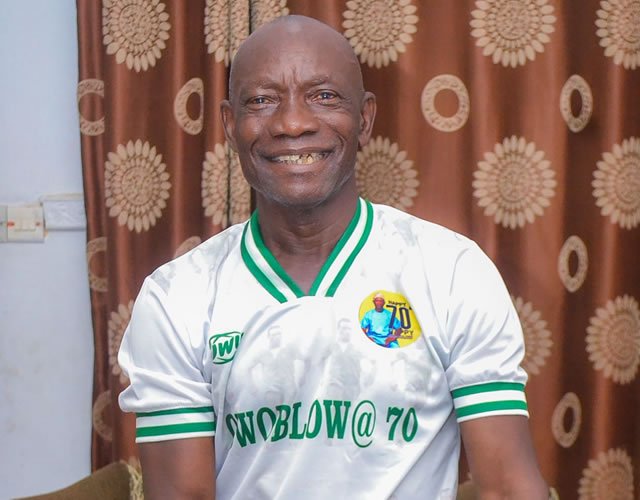
Dr Felix Owolabi Akinloye (MON) is a decorated former Shooting Stars and Green Eagles player. He was part of the Green Eagles team that won the first African Cup of Nations (AFCON) in 1980. In this interview, he speaks on how he developed his passion for football, experiences he had during his playing days and why the current crop of players need to show more commitment, especially to the national team. Excerpts:
First and foremost, during your playing days, you were popularly known as ‘Owoblow,’ how did that come to be?
During my playing days, radio commentaries on football were so popular. We still have them, but I don’t think commentaries on radio are as popular now as they used to be. Then, there were only few people who could afford television sets to follow football matches, so radio was very common. At that time, there were these commentators, the late Baba Ishola, Ishola Folorunso of Radio Nigeria and the late Tolu Fatoyinbo, popularly known as ‘Uncle Tolu,’ who died almost about 10 years ago; there was also the late Ernest Okonkwo. These three icons were key to the development of football commentary in Nigeria, and Radio Nigeria was the best radio station that Nigeria had at that time.
 The sports journalists at that time also worked hard to be different from the rest; they had ways of calling footballers, especially in exposing their work ethics, and this was to generate excitement among football lovers. Some players were identified as ‘rugged player,’ ’indefatigable player,’ ‘one man riot squared player,’ among others. So players were given different names based on their performances on the pitch.
So, in my case, they saw me as someone who was strong, skillful and intelligent; someone who could move through defenders and ‘blow’ them away. That was how ‘Owoblow,’ which is actually part of my name, Owolabi, came to be. This was also how Chief Segun Odegbami was give the nickname, ‘Mathematician.’
You said you could bulldoze your way through defenders, but can you remember the best defender you played against locally and internationally?
I was too bold during my playing days and I never had any defender who could come my way. I was a very good dribbler when I was on the ball and you can hardly get the ball off me. I had a strong heart, just like the David in the Bible. I never feared anybody. The more I see you and I know you, the more I decide to develop different tactics and plan to pass through you. So, there was never any time I had any challenge with defenders, rather, they were had nightmares when I played against them. So I thank God that I was endowed with that natural talent. It was natural. If I played football today, the next time, I would use a different pattern; I was so gifted with the natural talent by God. I could remember that anytime I had the ball, the crowd would cheer. I could remember a commentator saying, ‘Why is it that the whole crowd, 100,000 people, are always cheering Owoblow when he has the ball? It is so because he will ‘blow,’ even if he is not scoring. He uses his strength like no one else on the pitch.’ So I thank God for that.
But how did football start for you?
My father was a footballer. I remember in the olden days when our community had football matches against other communities, my father would take me along. I would hold on to his boots as we entered the pitch. Besides that, the missionaries in my town did the magic. You know, when the missionaries came to this part of the world, apart from trying to build churches, they introduced sports and the facilities were also provided in order to ignite the love in children. So every evening, children would go to the mission house to participate in one sport or the other. And that was how my passion in football started. Incidentally, I am a Catholic, and in the Catholic mission, we had opportunities to join the sports we love. I remember I was very excellent in all the sports. I grew up in the North, and when it was time to focus on just one sport, I decided on football. I remember my primary school, United Primary School, which was very close to the Ahmadu Bello Stadium, Kaduna, and that further influenced me. I also attended Government College, and then later Kastina Teachers College, I was always very active in sports in all these schools. So my journey from Kaduna to Kastina, to Kano, made the difference and established me as a player, and it was from there that I was invited to the national team.
 You won the AFCON Championship with the Green Eagles in 1980; can you share that glorious moment with us?
It was a great moment. It was a fulfilled time in my life, and it became another new journey in my life today, and each time I remember that period, I’m always on top of the world, that God granted me the opportunity and privilege to represent my country. In fact, that night, I did not sleep. No player, I repeat, no player in the national team slept that night. It was a celebration galore.
So I was on top of the world, and as a student at the University of Lagos, I just thought that the steps I had taken as a very young lad was beginning to manifest, to become the best of the best, especially trying to combine academics and football.
It was that night that we were asked to go to the Dodan Barracks to see the President of the country, at that time, the first civilian president of the country was Alhaji Shehu Shagari. We had dinner with Alhaji Shagari and other top government functionaries. And then, at the end of the day, he made a statement that we had brought Nigeria together since the civil war. The President gave us a lot of things. He promised each of us a house. Some individuals, like the late Chief MKO Abiola, gave us money. And that was the very first time I received the highest money in my life, N1,000.
So when I look back today, I am always thankful to God. Of that team in 1980, only few of us are alive today and I thank God. I just celebrated my 70th birthday last November. 24.
You also played for Shooting Stars; what is your relationship like with the team?
As a Shooting Stars player, once a soldier is always a soldier. Shooting Stars is an institution. The very first time I was asked to come and play for this club here in Ibadan, was in Algeria. We went to play for the All-African Games, and it was after that match that the late Chief Lekan Salami, who was one of the board members of the Nigeria Football 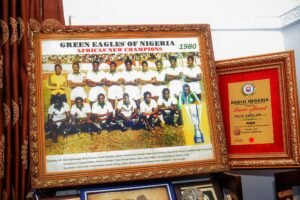 Association (NFA), saw me. He initially didn’t know I was a Yoruba boy because, at that period, I had spent my whole life in the North; so it was Segun Muda, who informed Chief Lekan Salami that I was a typical Yoruba boy, so he called me. When I fot to this flat in Algeria, he said ‘it is only a bastard Yoruba boy that will see Shooting Stars and will not want to play for the team; he said Shooting Stars represents the whole Yoruba, just like Enugu Rangers represents the Igbo. That was what touched me. I, however, told him that I would get back to him upon our arrival in Nigeria. It wasn’t easy telling my colleagues in the North then that I wanted to return to the South. I, however, said I wanted to go to be close to my parents, who were not getting old. I thank God that when I came to Shooting Stars; even before Shooting Stars, I was being lured by many clubsides, but I said Shooting Stars is an identity and the club stands for the Yoruba. Then, Abiola Babes, Insurance, Rangers and other clubs came for me, but I insisted on signing for Shooting Stars.
 You have seen it all as far as the football is concerned in Nigeria; how will you rate the current national team?
That will depend on how you view it. During my time, it is the desire of every Nigerian player to rise through the ranks of the local league, from ICC, now Shooting Stars, Enugu Rangers, Bendel Insurance, among others and then join the national team. Then, you would have proved your mettle at the home front, in front of fans, before you can be called up to the national team. Unfortunately, I cannot rate the standard of the national team today because the majority of the players are not from the local league. I thank God that I am alive today and a living witness to have played through all the age groups of various football competitions to get to the national level. It is a commitment to play for one’s country. Today, we have about 250 million Nigerians and anybody selected to play for the national team should see it as a privilege.
I have no regrets playing for Nigeria. Nigeria is a good country and I take pride to have played for the country. Because of the opportunity of playing for Nigeria, I have been exposed; I have visited many countries of the world. Then, we fought for our shirts; we showed commitment and zeal, so there is a real difference between then and now. The commitment was overwhelming for players and any player not doing well would be told by the supporters immediately; they won’t even wait for the coach to do that. So that kept us on our toes, but I can’t say the same today when it comes to commitment.
What advice would you give to young footballers looking to follow in your footsteps?
Today, everybody is in a hurry. People just want to make money. Everybody is in a hurry to go and play professional football, but God knows everything. Our destinies are not in our hands. There will be challenges on the way; I faced challenges as well. I remember when someone referred to me as a ‘one-legged player.’ It was so disturbing to me then, but God has other things in stock for me. In all the matches we played, I scored or provided assists. So it was the late Professor Sam Akpabot of the University of Ibadan, who was also a columnist/journalist, who said the ‘one-legged player’ has successfully taken Nigeria to the final of the African Nations Cup. In fact, I gained more publicity with the ‘one-legged’ comment, which was aimed to demoralize me, not knowing God had other channel for my promotion. So today’s crop of players should not see anything as a problem, it can be a way God has designed to promote them to the next level. They should not be distracted; most of these side talks are distractions and they should just put their trust in God and work hard to be the best.