
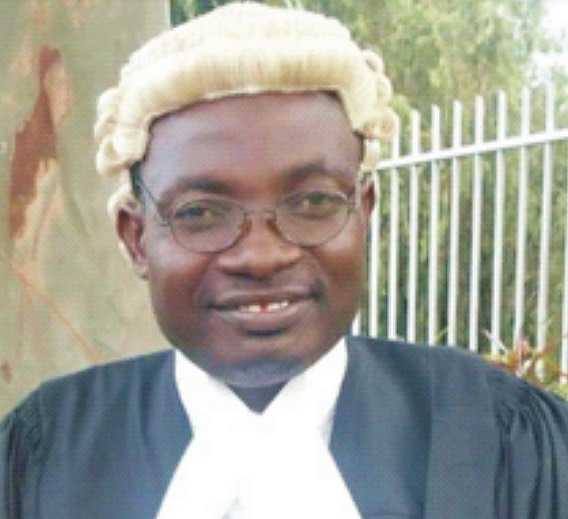
Mr. Rotimi Stephen Babatunde is the Principal Partner of Rotimi Babatunde and Co. He is a brilliant, experienced and resilient Legal Luminary. He came from a humble background and actually had his Law School fees cooperatively paid by helpers. However, by dint of his unrelenting efforts, diligence, focus and belief in himself, he established a successful Law firm, and became an employer of labour. He handles cases connected with Dispute Resolution, Corporate and Commercial Law. In this interview, he shared his background story, and also gave expository analyses, constitutional provisions I and opinions on Executive Immunity, Federal Character Commission, creation of State Police and Election issues. The excerpt is as follows:
Welcome to Interviewers Magazine, sir. Can you briefly tell us about yourself and family background?
Thanks very much, sir. My name is Rotimi Stephen Babatunde. I am a native of Oka-Akoko in Akoko South-West Local Government of Ondo State. My parents (now late) were subsistent farmers and I did assist them in their farming activities before I gained admission into Ondo State University, Akungba-Akoko (now Adekunle Ajasin University) where was offered English and Literary Studies in year 2000. After my Bachelor’s degree, I worked as a Secondary School teacher, where I specialized in English Language and Literature in English for the Senior Secondary School students. In the year 2005, I proceeded to Lagos State University to study Law and graduated in the year 2011. Regrettably, however, due to paucity of fund, I could not proceed to the Nigeria Law
School for the mandatory one-year law programme that would make me a full-fledged Barrister and Solicitor of the Supreme Court of Nigeria. With the intervention of some well-meaning Nigerians, I was able to pay my tuition fee to the Council of legal Education in the sum of N295,000.00 in Year 2014. I was called to the Nigerian Bar in 2015. I am happily married and blessed with children.
Sir, what prompted your choice of profession?
I had been attracted to law since my as childhood days. My family and relations tried to dissuade me from studying law, as they believed it is only for the children of the rich; and also that as a lawyer, one must belong to a confraternity before one could succeed in the profession.
What are your views regarding Section 308 of the Constitution of the Federal Republic of Nigeria 1999 (as amended) as it concerns the Executive Immunity? Should that particular section be expunged?
Section 308 of the 1999 Constitution of the Federal Republic of Nigeria provides immunity from legal action in a personal capacity, for the President, the Vice President, the Governor and of the Deputy Governor of a state respectively. It simply means that during their tenure in office, no civil or criminal proceeding can be brought or continued against any of the public office holders in which relief is sought as against him in his personal capacity. In will this instance, any suit pending against any of this public officers cannot be continued during his term in office, Such suit is either adjourned, that is, adjourned without a fixed date, or, amicable settlement by both parties.
However, there are some exceptions to the Immunity Clause given to the public officers. These include: i. they may be sued in their official capacity (section 308 (2), ii. They may be joined a nominal party (section 308 (2)), iii. Impeachment proceedings may be instituted against the President or the Vice President by the National Assembly (section 143 of the constitution). Impeachment against Governor or Deputy Governor by the applicable House of Assembly (section 188). The constitution did not provide immunity from impeachment. The constitution also ousted the jurisdiction of court to inquire into any effort to remove or any removal from office by way of impeachment. iv. They are not immune to election petitions. Sections 272 (2) and 285 of the constitution draws a distinction between civil proceedings and election petitions. The intendment of draftsmen is to prevent any form of distraction of the aforementioned public office holders by way of any litigation while in office. It is pathetic to note however, that every succeeding government, be it the President or the Governor of a State, the case may be, lacks the political to sue or prosecute their predecessors singularly for political reasons. Personally, I would not subscribe or canvass that section 308 of the 1999 constitution as amended be expunged. Rather, the machinery of law be set in motion to prosecute or sue any ex-president, vice president; ex-governor or ex-deputy governor as the case may be.
Tell us what you think about the huge clamour for the creation of State Police in Nigeria, what are the Implications of the provisions of Section 214 of the 1999 Constitution (as amended)?
It is true that many have called for the amendment of Section 214 of the 1999 constitution of the Federal Republic of Nigeria to decentralize the nation’s security and policing system. I am fully in support of the amendment to decentralize our policing system by having state police. Little do we need to wonder why different schools of thought have strongly refuted the preamble of the 1999 constitution which begins with “We the people of the Federal Republic of Nigeria…………and to provide for a constitution…..”. It is seen as a creation of selected few (by the Retired Gen. Abdusalam) people who did not carry the general populace along. The Section 214 is a relic of military administration. The draftsmen who had been ruled by the military men for many years had the thought of the Unitary system of government at the back of their minds. It will be absolutely incongruous to centralize the Nigeria police in a Federal state like Nigeria. Instead, each federating units or states is of necessity, expected to have its own police with a view to reducing the crime rate and curbing the spate of insecurity which is prevalent in our society. Sequel to the yearnings and agitations of the Nigerians towards the amendment of section 214 of the constitution, State police appears to become a reality after President Bola Ahmed Tinubu and the State Governors have agreed to work on the modalities of establishing the state police. Clause 12 of the House of Representatives’ Bill has completely replaced offending Section 214 of the 1999 constitution (as amended) with the following provisions: “214. (1) The following bodies are established: (a) The Federal Police; and (b) State Police.”
The Federal Character Commission was set up to ensure that no section of the country or ethnic group will dominate the political environment of the country based on the diverse nature of the country. What are your views about this commission, has it achieved its aims and objectives?
The Federal Character Commission (FCC) is a Federal Executive body established to implement and enforce Federal Character principle of fairness and equity in the distribution of public posts and socio-economic infrastructures among the various federating units of the Federal Republic of Nigeria. It is beneficial to Nigerian nation as it protects the rights of the minority groups and as well assist the less privileged in the society by ensuring an equitable distribution of opportunities, However, meritocracy is slaughtered at the altar of mediocrity in government establishments, instead of fixing a round peg into a round hole, it is a square peg into a round hole. Admissions into our tertiary institutions are no longer based on merit, and these are some of the drawbacks of Federal Character. My candid view about the commission is that since its existence in 1996, the commission has been levelled with marginalization and nepotism accusations. A clear instance was when Ex-President Muhammadu Buhari approved the appointment of the Chairman and the Secretary of the Commission who are from North-Central and North-East respectively and the said appointment defiantly offends the fundamental value and culture of the Commission violated the historical tradition of rotating the positions between North and South not North and North whatsoever. The appointment was challenged in the law Court. Without any equivocation, I can conclude that since the creation of the Commission in 1996, it has not been able to achieve its aims and objectives.
How can you rate the recently concluded elections in Nigeria? INEC cited technical glitch as a reason why the BVAS was not properly utilized during the conduct of the elections. What can you say about the constitutional Implications of such issue in future elections in Nigeria?
In my opinion, the recently concluded National elections into the various political offices in our national polity was fair enough but not absolutely perfect. The ‘technical glitch’ is nothing but human error, which is inevitable. It must be noted that in all human endeavours, there must be one problem or the other and, proffering solutions to the existing problems should be what we look forward to seeing. There should be an alternative to the usage of BVAS in our subsequent elections to avoid the disenfranchisement of eligible voters.